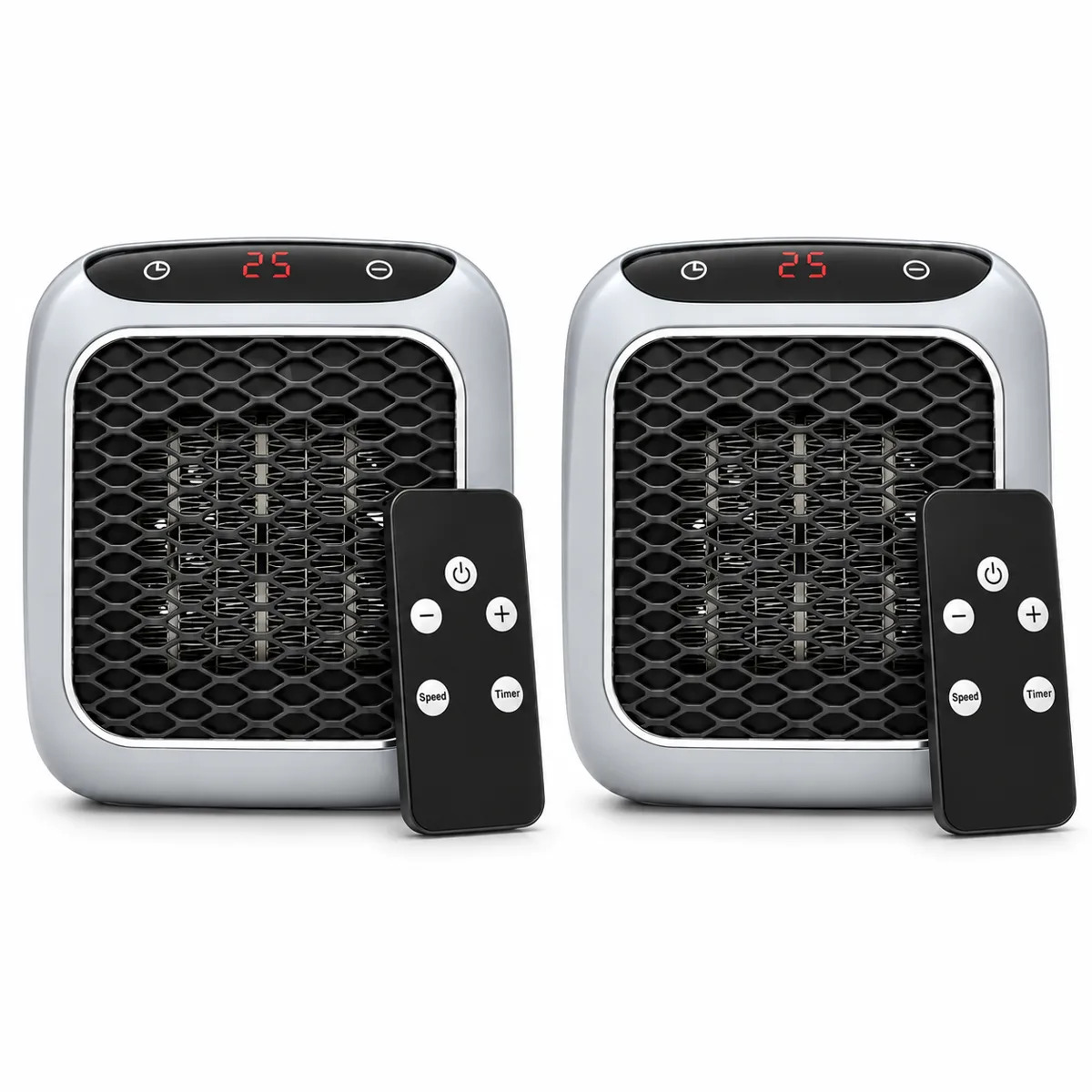
What does RapidHeat actually do?
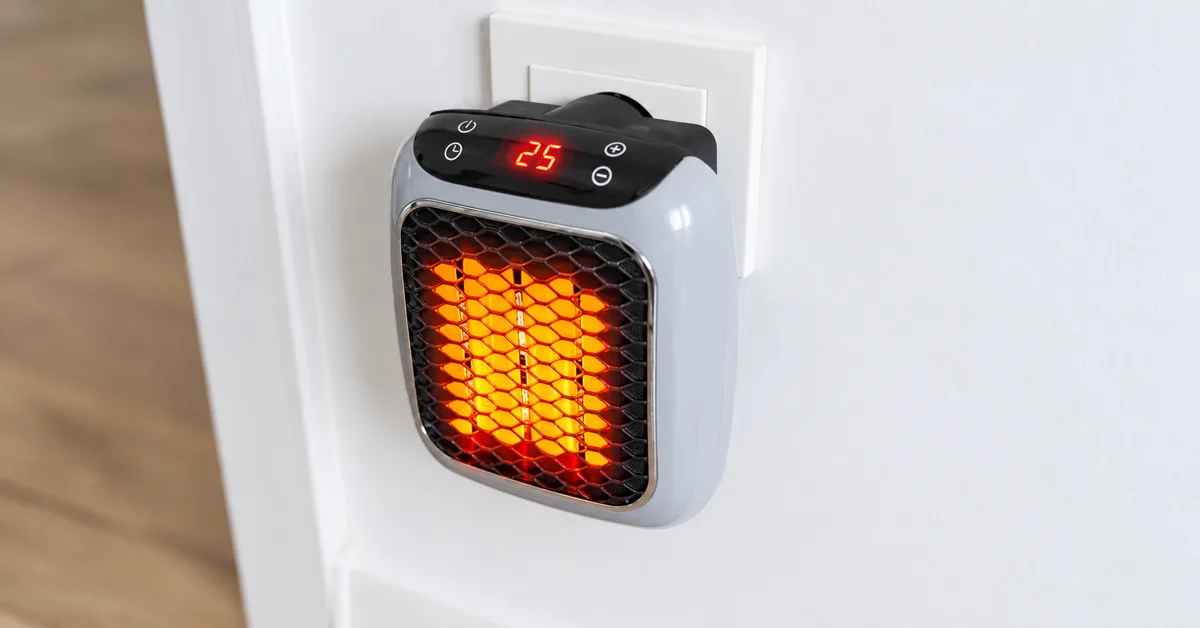
Inside RapidHeat
- 1Wall socketPower flows straight from your Irish 3-pin socket. No cable, no installer.
- 2Ceramic plates heat upPTC ceramic plates warm quickly and limit their own temperature.
- 3Quiet fan pushes warm airAir is drawn over the plates and sent into the room (about 45 dB).
- 4Thermostat takes overWhen the room reaches your set temperature, heating pauses, then restarts as it cools.
RapidHeat uses PTC ceramic plates to turn electricity into heat, with a fan moving warm air into the room. Low power draws 400W and high power draws 800W. These are modest outputs suited to targeted heating, not a miniature substitute for the capacity of a central heating system.
The stated performance is warming a small room up to about 12 m² in under five minutes. Treat that as a small-room warm-up claim, not a guarantee that a cold room reaches a particular temperature in every condition. The starting temperature, insulation, draughts and ceiling height all affect the outcome.
We have not independently timed or measured that performance. This guide explains whether the specification makes sense for your intended use, rather than reporting a hands-on test. For the underlying mechanism, see how RapidHeat works.
Why might a small heater struggle to warm a room?
The heater must replace heat escaping through windows, walls, the ceiling and draughts. If that heat loss is greater than the heat it supplies, the room will not become as warm as you want, however long you wait. Closing a door can help isolate a small space, but it cannot fix inadequate insulation.
An open-plan room effectively asks the heater to warm a much bigger volume of air and surrounding surfaces. A poorly insulated conservatory adds extensive cold glazing to the problem. In either case, buying a small appliance because it is inexpensive per hour risks solving the wrong problem.
If the heater seems unsuitable, check the room and placement rather than assuming that a higher thermostat setting increases maximum output. The thermostat sets the temperature target; it does not turn an 800W heater into a 2kW one. A bigger heating requirement needs an appropriately sized solution.
Do the thermostat, timer and remote make a difference?
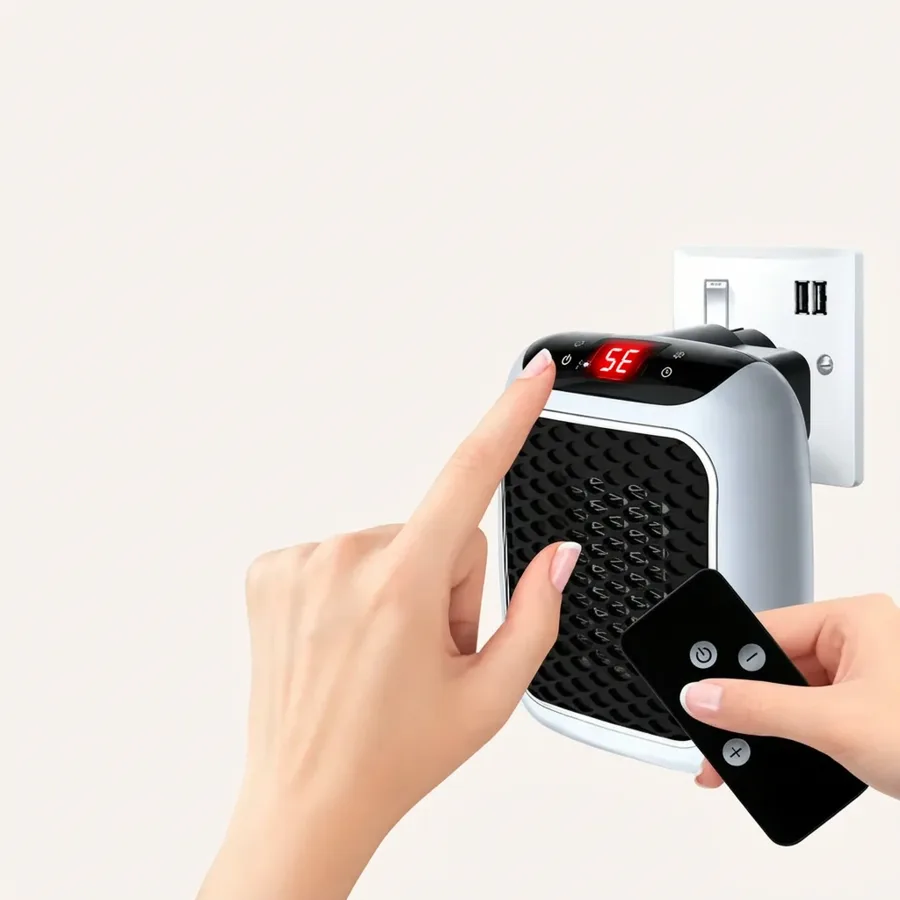
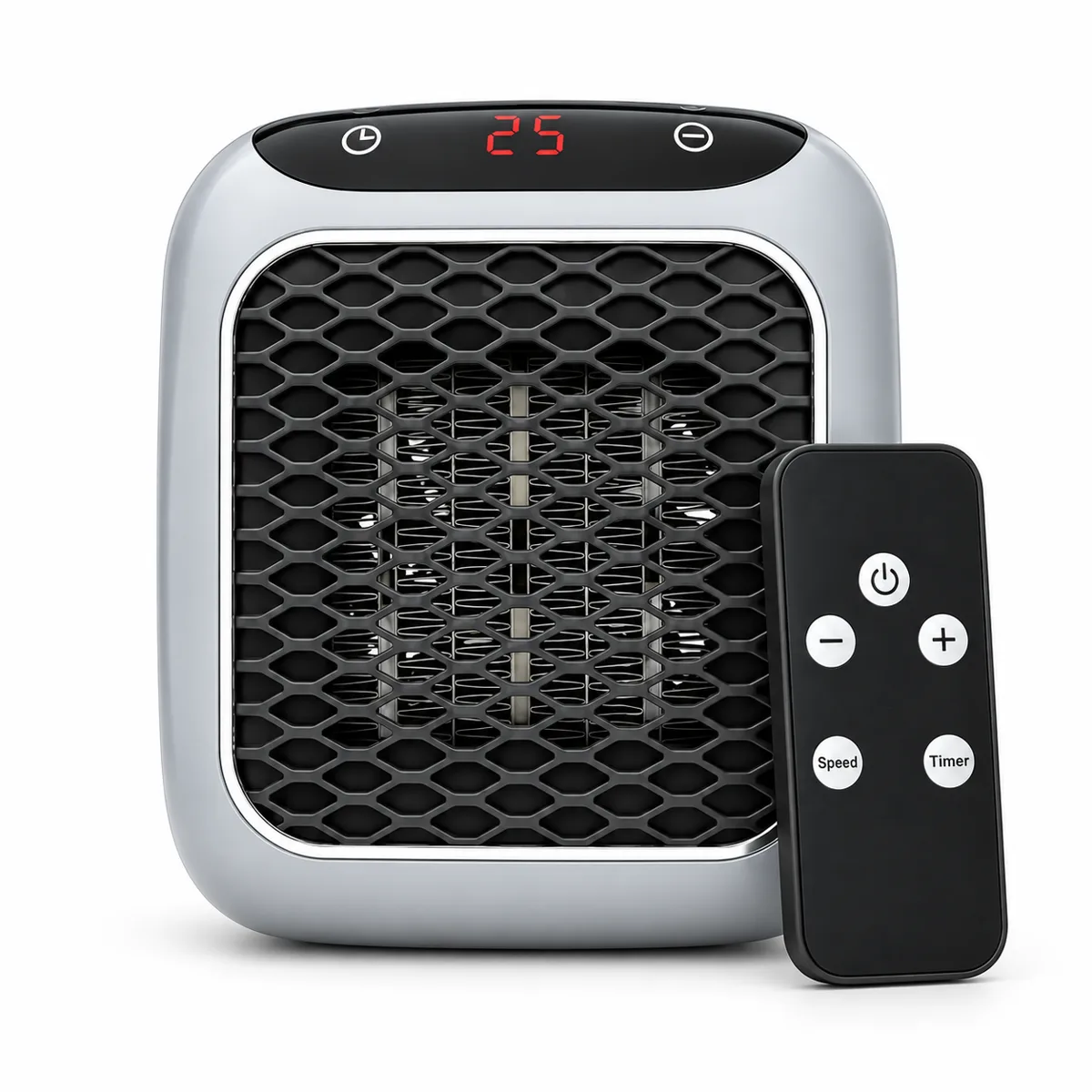
An adjustable thermostat with an LED display helps you choose a comfort setting, while the programmable timer can limit a session to the period you need. A remote allows convenient adjustments. These are useful controls, but none changes the amount of heat available at the maximum 800W setting.
Once a room reaches the thermostat setting, the heater can cycle rather than drawing full power continuously. In a cold room that never reaches the target, it may run for much more of the session. That is why a timed session does not necessarily consume the same electricity in every room.
The specification also includes overheat protection, auto shut-off and an antimicrobial air filter. Do not interpret the filter as a promise of health improvements or the safety features as permission to block airflow. Useful features work best when the basic room and placement requirements are already met.
Is it better than a fan heater or oil-filled radiator?
Cost per hour at full power
- RapidHeat · low (400W)€0.14
- RapidHeat · high (800W)€0.28
- Halogen heater (1,200W)€0.42
- Oil radiator (1,500–2,500W)€0.53–€0.88
- Fan heater (2,000W)€0.70
RapidHeat is a ceramic heater that also uses a fan; ceramic and fan are not mutually exclusive categories. A conventional 2kW fan heater has more maximum output, while an oil-filled radiator usually provides heat without a fan and takes a different approach to delivering warmth. Suitability depends on the room, controls and your preferences.
All resistive electric heaters provide about the same heat per kWh of electricity consumed. An oil-filled radiator does not create free heat after switching off: it releases heat stored while drawing power. Likewise, ceramic plates do not multiply electricity into extra energy.
RapidHeat’s practical strengths are its wall-socket format, selectable low power and convenient controls. Its limitations are the same small output and positioning requirements that make it compact. Read the RapidHeat and oil heater comparison if you are choosing between formats rather than simply comparing hourly figures.
Which rooms suit a 400W or 800W plug-in heater?

| Room or situation | Suitability | What to consider |
|---|---|---|
| Small office or box room | Potentially suitable | Up to about 12 m², with manageable heat loss. |
| Small bedroom | Potentially suitable | Use while awake; keep clear of curtains and bedding. |
| Large open-plan living area | Not suitable as sole heating | 800W is limited for a large connected space. |
| Poorly insulated conservatory | Not suitable on its own | Heat can escape faster than a small heater replaces it. |
| Bathroom or wet area | Not suitable | RapidHeat is not IP-rated. |
Start with the room rather than the offer. RapidHeat is intended for a small space up to about 12 m², not an entire floor. Measure length and width and multiply them to estimate floor area; then consider draughts, ceiling height and the amount of exposed glass. Two rooms of equal size can have very different heating needs.
A closed door helps keep warmth where you need it, provided normal ventilation is maintained. A cold, poorly insulated room may lose heat too quickly for 800W to maintain the comfort you want. Buying extra units is not a substitute for choosing an appropriate heating system for a difficult space.
1. Small bedroom
Up to about 12 m² with the door closed. Use the timer; don't leave it on unattended overnight.
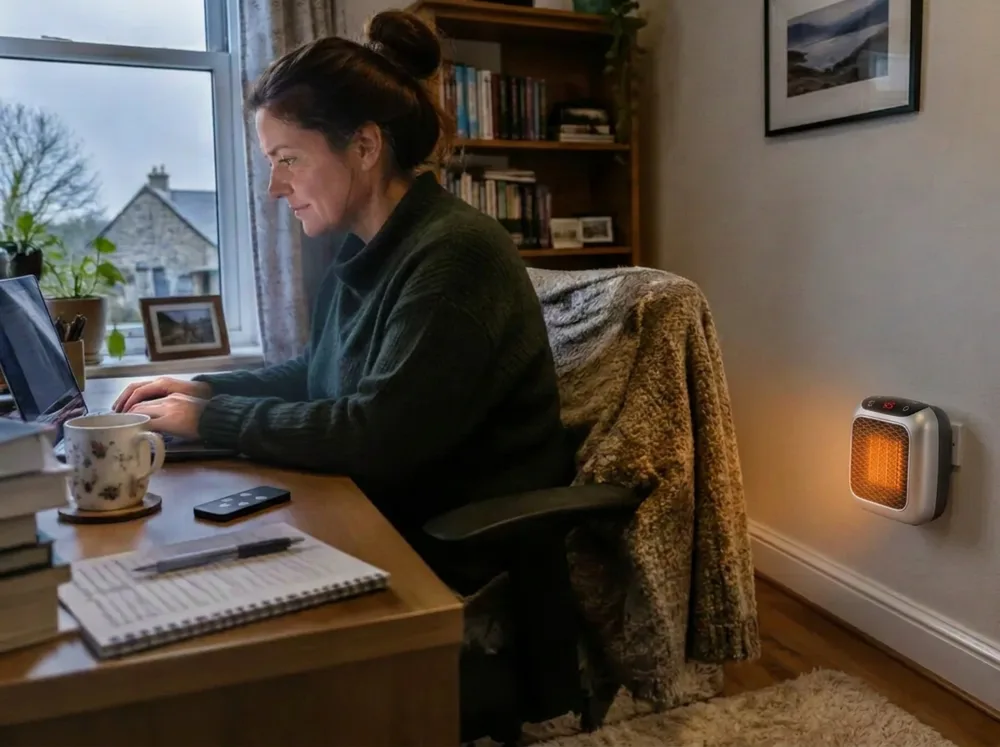
2. Home office / box room
Warms the space you work in without heating the whole house.

3. Sitting room
Fine as a top-up in a small, closed room; not enough on its own for a large or open-plan room.
Conservatory or bathroom
Conservatories lose heat too fast; RapidHeat has no IP rating, so never use it in a bathroom.
How much does RapidHeat cost to run in Ireland?
Running cost calculator
What would RapidHeat cost you?
Setting
- Per hour
- €0.14
- Per day
- €0.56
- Per week
- €3.92
- Per month
- €16.80
Maximum cost at €0.35/kWh. The thermostat switches it off once your room is warm, so most people pay less.
| Heater type | Typical power | Cost per hour* |
|---|---|---|
| RapidHeat (low) | 400W | €0.14 |
| RapidHeat (high) | 800W | €0.28 |
| Fan heater | 2,000W | €0.70 |
| Oil-filled radiator | 1,500–2,500W | €0.53–€0.88 |
| Halogen heater | 1,200W | €0.42 |
*At full power and an electricity unit rate of €0.35/kWh, close to typical Irish standard tariffs. Thermostats cycle heaters off once a room is warm, so real costs are usually lower.
These figures compare electricity drawn at the stated power, not equal heating performance. A higher-output heater delivers more heat while it is running, so a lower hourly figure does not prove that RapidHeat can warm the same space for less. Multiply your own unit rate by 0.4 on low or 0.8 on high to estimate your hourly cost.
Will RapidHeat actually reduce my electricity bill?
A resistive electric heater turns about 1 kWh of electricity into 1 kWh of heat. PTC ceramic plates do not create extra energy, and there is no sound basis for promising a dramatic percentage reduction in household bills simply by changing heater type. Lower power means a lower hourly cost, but also less heat output.
The sensible opportunity is selective heating: warming the small room you occupy instead of heating unused rooms unnecessarily. Four hours a day on the 400W setting costs about €0.56 a day, or roughly €17 over 30 days, at €0.35/kWh. That assumes it draws the full 400W throughout those hours; thermostat cycling changes actual consumption.
If you add RapidHeat while keeping the rest of your heating schedule unchanged, it adds electricity use. Compare the whole household routine, not just the wattage printed on two heaters. Our RapidHeat energy-saving guide explains that distinction in more detail.
What safety checks should I make before using it?
RapidHeat has overheat protection and auto shut-off, but these are safeguards rather than permission to ignore its surroundings. It needs an appropriate wall socket with clear space around the heater and unobstructed airflow. Do not plug it into an extension lead, cover it, or position it beside curtains, bedding or other combustible materials.
It is not IP-rated, so do not use it in bathroom zones or other wet areas. A convenient bathroom socket would not change that restriction. Keep children and anyone who may struggle to recognise a hot appliance away from direct contact, and stop using the unit if the plug, socket or appliance appears damaged.
The programmable timer is useful for limiting a heating session, not a reason to leave a portable heater running unattended. Follow the supplied instructions, and use bedroom heating while you are awake rather than treating the device as overnight background heating.
- Plug directly into a wall socket, never an extension lead or adaptor
- Keep curtains, bedding and clothes clear of the front
- Never use in a bathroom or wet area (no IP rating)
- Don't leave it running unattended or while you sleep
- Supervise children and pets near any heater
- Unplug and let it cool before cleaning the filter
How can I keep a small room warmer for less?
First reduce avoidable heat loss: close the door to unused adjoining spaces, draw curtains without bringing them near the heater, and deal with obvious draughts without blocking necessary ventilation. Warm clothing and a sensible comfort setting can reduce the amount of extra heat you need. Use the timer to match the hours you actually spend in the room.
Read your electricity bill before assuming a quoted running cost applies to you. Night-rate and smart tariffs can charge different amounts at different times, and a cheaper period is useful only if you need heat then. Do not heat an empty room just to take advantage of a lower unit rate.
For persistent cold, look beyond a portable appliance. SEAI provides information about home energy improvements and grants; check the current schemes and your eligibility. Fuel Allowance may help eligible households with heating costs. Neither should be treated as a product discount or a promise that this heater will suit your home.
- Heat the room you are in, not the whole house
- Close the door to keep the warmth in
- Set the thermostat instead of running flat out
- Use the timer so it switches off on its own
- Start on high, then drop to low once warm
- Block draughts at doors and windows
What are the honest advantages and drawbacks?
The main advantage is straightforward targeted warmth without taking up floor space. In a suitable small home office, that may be more convenient than moving a larger heater. The stated sound level is about 45 dB, which should be understood as audible fan operation rather than silent heating.
The main drawback is limited heating capacity. A heater can be working correctly and still be wrong for a large room. The need for a clear wall socket also rules out some otherwise convenient spots, particularly where furniture, bedding or curtains are close by.
- Good fit: a small dry room with manageable heat loss and a clear direct wall socket.
- Poor fit: a bathroom, a large connected space or an expectation of whole-house heating.
- Evidence limit: this page explains the stated specification and does not claim independent test results.
Works well for
One small room up to about 12 m², quick warmth where you sit, low cost per hour, no installation, quiet fan, thermostat, timer and remote.
Not the right choice for
Whole-house heating, large or open-plan rooms, draughty conservatories, bathrooms or wet areas, or anyone who needs an extension lead.
What happens after ordering, and can I return it?
Delivery is free to every county in the Republic of Ireland. Dispatch is within 1–2 working days and delivery is 2–5 working days; these are separate stages, so do not read the delivery figure as a guaranteed order-to-door deadline. Check the Irish delivery information before arranging to be home for a parcel.
There is a 30-day money-back guarantee from delivery, alongside your statutory rights under Irish and EU consumer law. Read the returns policy before buying so you understand the process rather than assuming every possible return expense or circumstance is covered. The guarantee provides a route back if the purchase is unsuitable; it is not evidence of heating performance.
Support is available at support@rapidheatie.com, with a reply within one working day. Keep your order confirmation and explain clearly whether your question concerns delivery, operation or a return. Optional delivery protection costs €4.95; because it is optional, check whether you want it before completing payment.
Should I buy RapidHeat for my room?
One costs €59, two cost €89, three cost €119 and four cost €179, including VAT. The three-pack is best value per unit at €39.67, but a single heater is the sensible starting point if your question is whether it suits one room. Check the RapidHeat bundle costs without assuming that a larger order guarantees better heating.
If you have a small dry office, a suitable socket and realistic expectations, the specification offers a reasonable basis for considering it. Read our honest RapidHeat review for the practical advantages, limitations and costs before deciding.
Decide what success would mean before ordering: useful warmth during the hours you occupy a suitable room, within a running budget you understand. Do not judge success against an unsupported promise of heating the whole house or cutting bills automatically. Those are not jobs this heater is designed to do.
Who RapidHeat is not right for
We'd rather you buy the right heater than return the wrong one. RapidHeat probably isn't for you if:
- Anyone needing a single appliance to heat an entire house or a large open-plan living area.
- Households seeking bathroom heating or a heater for another wet location; RapidHeat is not IP-rated.
- People expecting guaranteed bill reductions without changing their heating use or reducing heat loss.
- Anyone without a suitable clear wall socket, or who would need to use an extension lead.
Frequently asked questions
Does RapidHeat really heat a room?
Yes, a small one. At 400W or 800W it is made to warm one closed room up to about 12 m². It will not heat a large, open-plan or very draughty room on its own.
How long until I feel the heat?
The ceramic plates warm up within moments and the fan pushes warm air out straight away. The stated warm-up for a small room is under five minutes, depending on how cold and draughty it is.
Is RapidHeat a scam?
No. rapidheatie.com is the official Irish store, with clear prices including VAT, secure Shopify checkout, free Irish delivery and a 30-day money-back guarantee on top of your consumer rights. See our page on whether RapidHeat is legit for how to check you are buying from the real seller.
Does RapidHeat really work?
RapidHeat is a 400W/800W ceramic heater designed to warm a small room up to about 12 m². It can be a practical targeted heater, but it will not replace whole-house heating and we have not independently verified its stated under-five-minute warm-up.
Why is my room still cold with a small heater?
The room may be losing heat faster than the heater can supply it, especially if it is large, draughty or open to other spaces. A higher thermostat target does not increase RapidHeat’s maximum 800W output; reassess room suitability and safe placement.
Does a ceramic heater give more heat per kWh?
No. Like other resistive electric heaters, it gives about 1 kWh of heat for 1 kWh of electricity consumed. Any saving depends on heating less space, using lower power when sufficient, and limiting unnecessary heating time.
Can I use RapidHeat in a bathroom?
No. RapidHeat is not IP-rated and should not be used in bathroom zones or wet areas, even if a socket is available. Choose a heating solution designed for that location rather than relying on the heater’s overheat protection.
Is RapidHeat cheaper to run than a 2kW fan heater?
At €0.35/kWh, RapidHeat costs €0.14 an hour on low or €0.28 on high, compared with €0.70 for a 2kW fan heater at full output. It also supplies less heat, so those figures are not a like-for-like room-heating saving.
Can RapidHeat replace central heating?
Not as whole-house heating. It may be useful for a small occupied room, but an 800W heater cannot be expected to provide the output needed by large connected spaces, several rooms or a poorly insulated conservatory.
Does RapidHeat have a money-back guarantee?
Yes. The 30-day money-back guarantee starts from delivery, and statutory Irish and EU consumer rights also apply. Read the returns policy for the procedure and contact support with your order details rather than assuming a refund happens automatically.