What type of heater suits a home office?
Start with the room rather than the advertised wattage. A small enclosed room with reasonable insulation is a different task from a draughty space with an open door. Portable electric heating makes most sense when you need one occupied room warmer for a limited period.
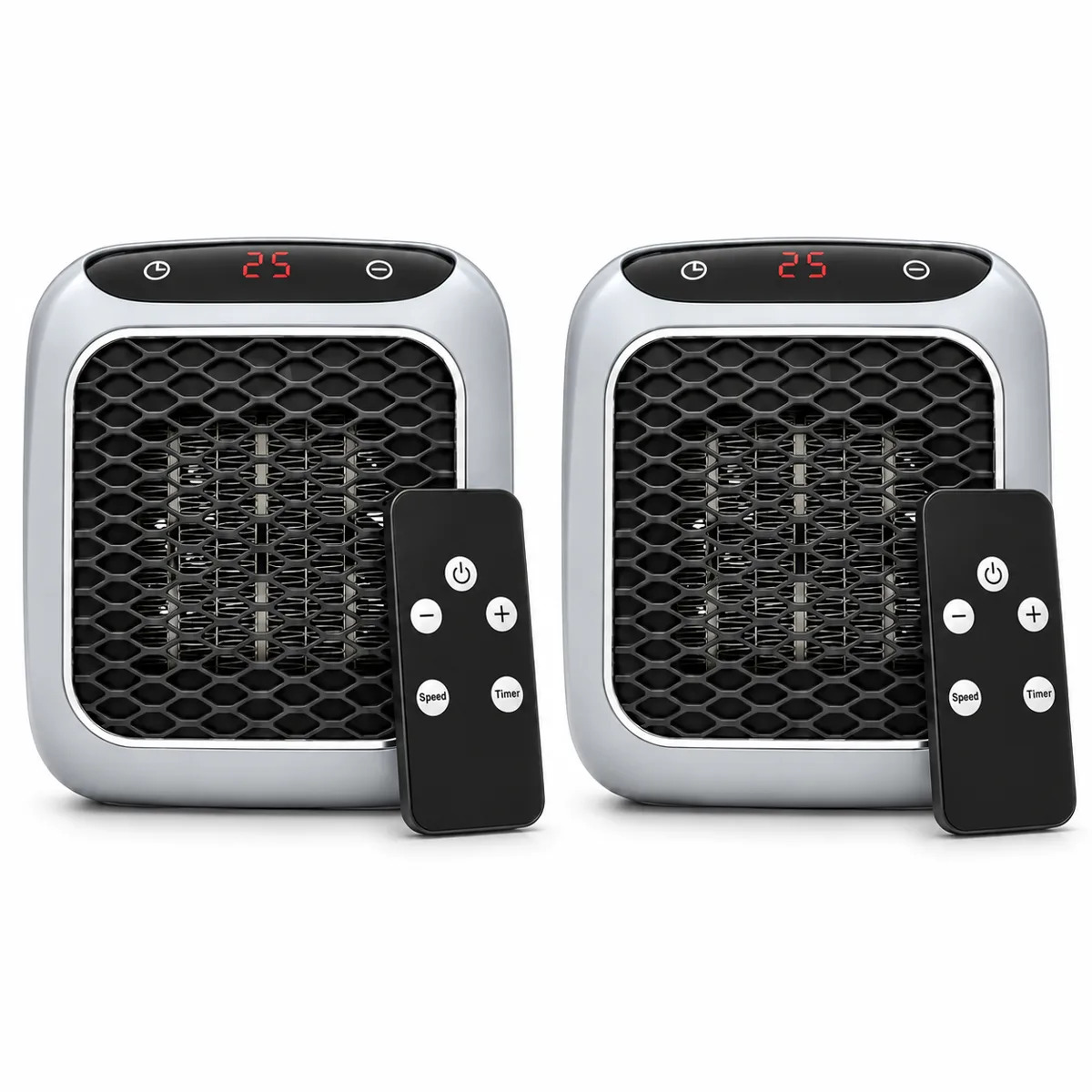
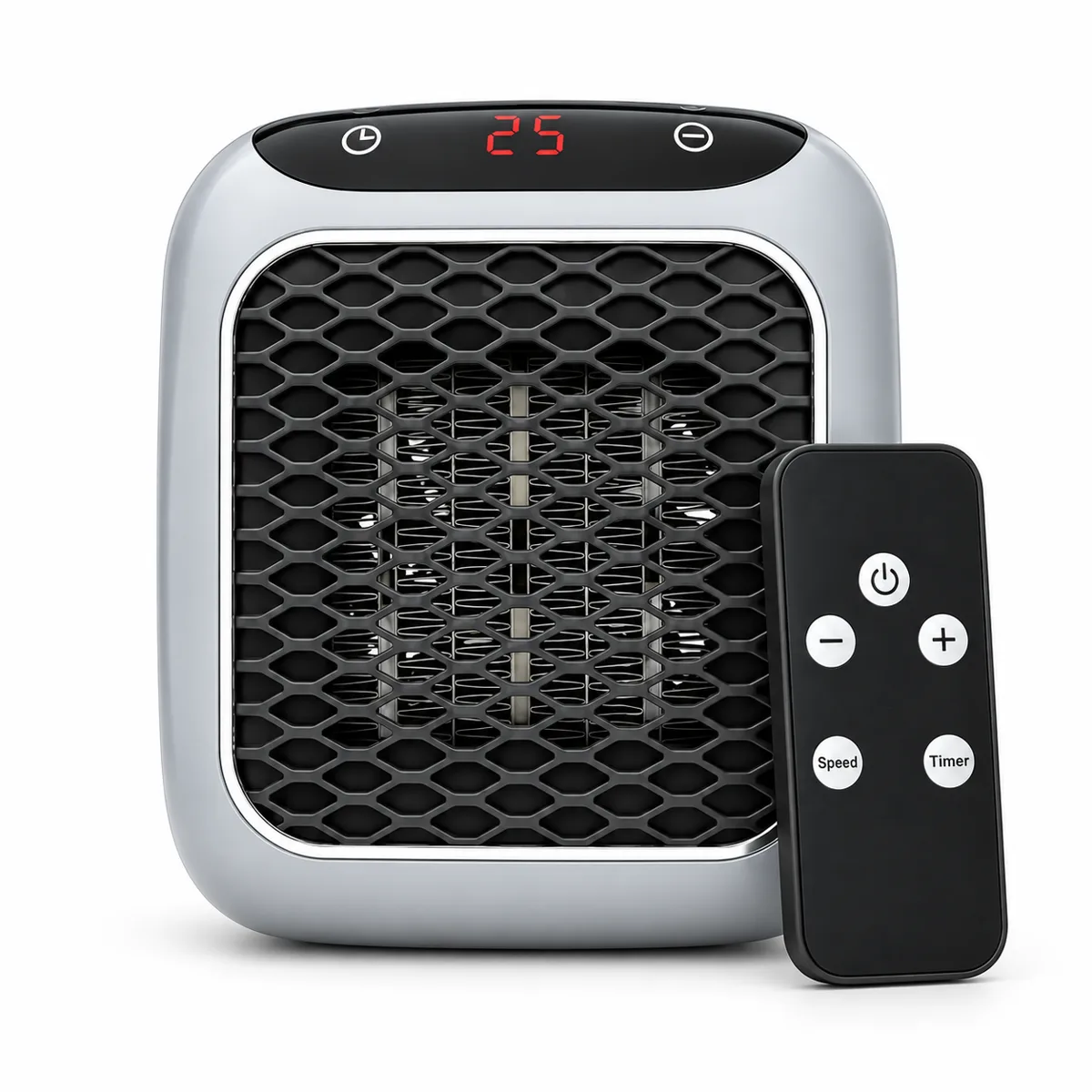
RapidHeat is a wall-socket ceramic heater with 400W low and 800W high settings. Its PTC ceramic plates and fan deliver heat into the room, while the adjustable thermostat helps control the temperature. It is supplementary heating, not a replacement for a properly sized whole-house system.
What size room can RapidHeat heat?
| Room or condition | Practical guidance |
|---|---|
| Small enclosed room below about 9 m² | A reasonable candidate; check insulation and socket position. |
| Room around 9–12 m² | Within stated coverage, but heat loss still matters. |
| Larger room or open doorway | Do not assume one 800W heater is enough. |
| Damp or very draughty room | Address the underlying problem rather than buying extra units. |
The stated room coverage is up to about 12 m², with warmth in under five minutes in suitable conditions. That is not a promise that every room will reach your preferred temperature that quickly. Ceiling height, cold walls, draughts and outdoor weather all affect the result.
How much does a plug-in heater cost to run in Ireland?
| Heater type | Typical power | Cost per hour* |
|---|---|---|
| RapidHeat (low) | 400W | €0.14 |
| RapidHeat (high) | 800W | €0.28 |
| Fan heater | 2,000W | €0.70 |
| Oil-filled radiator | 1,500–2,500W | €0.53–€0.88 |
| Halogen heater | 1,200W | €0.42 |
*At full power and an electricity unit rate of €0.35/kWh, close to typical Irish standard tariffs. Thermostats cycle heaters off once a room is warm, so real costs are usually lower.
What would a typical working day cost?
Eight hours continuously on low uses 3.2 kWh, costing €1.12 at €0.35/kWh. One hour on high followed by seven hours on low uses 3.6 kWh and costs €1.26. These are full-power examples, not predicted bills: thermostat cycling and your actual tariff change the total.
A lower wattage also means less heat output. All resistive electric heaters turn roughly one unit of electricity into one unit of heat, so compare warmth delivered as well as the hourly price. Our electric heater efficiency guide explains why room-by-room use matters more than efficiency slogans.
Where should I position the heater safely?
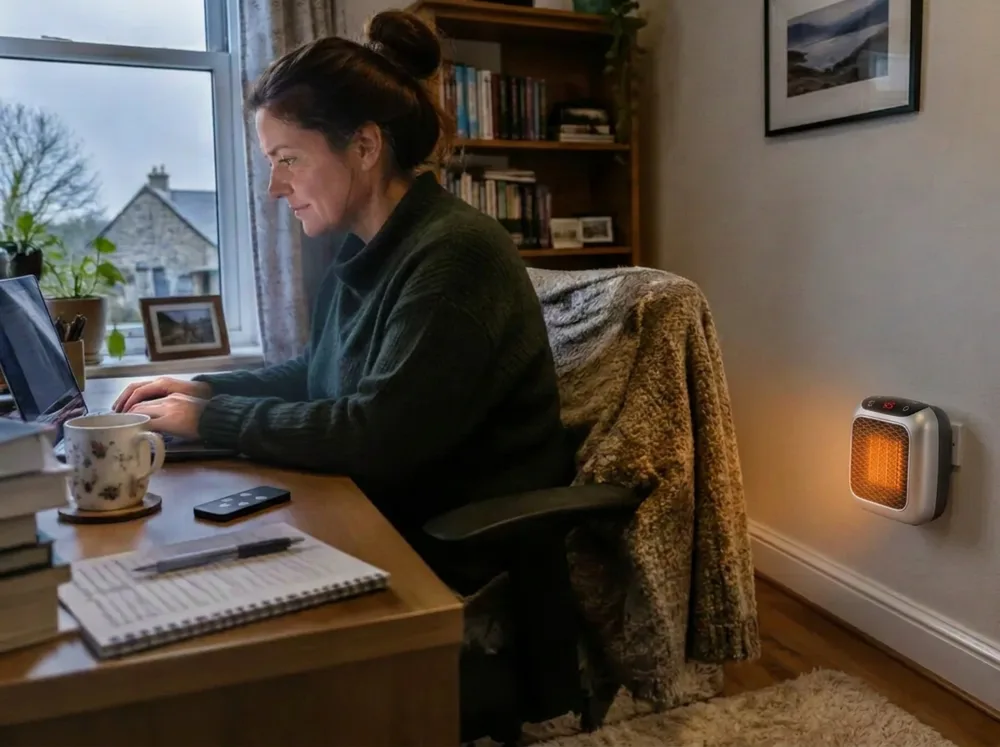
Use a sound, accessible Irish/UK Type G wall socket with a clear area around it. Never use an extension lead, adaptor arrangement or trailing connection to reach a more convenient position. If the socket is loose, damaged or shows signs of overheating, stop and have it checked.
Keep paper stacks, desk curtains, bags and loose cables away from the heater and its airflow. A socket hidden behind a desk or beneath hanging clothing is not automatically a suitable location. Keep drinks away, and switch the heater off when leaving for lunch or finishing work.
Overheat protection and auto shut-off are useful backup features, not permission to cover the heater or leave it unattended. Read the RapidHeat setup and safety guidance before first use.
Is RapidHeat quiet enough for calls and concentration?
RapidHeat has a fan and an operating noise level of about 45 dB. Quiet does not mean silent: whether that is acceptable depends on your hearing, the room and background noise. Do not assume a fan heater will disappear into the background simply because it is compact.
For video calls, avoid placing the heater beside a microphone. If fan noise distracts you during detailed work, a suitably sized oil-filled radiator may be a more comfortable option. Compare the trade-offs in our ceramic and fan heater guide.
How should I use the thermostat and timer?
Choose a comfortable target rather than turning the thermostat up unnecessarily. A high target does not increase the heater beyond its rated output; it can simply keep it running longer. Start on high if needed, then try low once the room feels comfortable.
Use the programmable timer to limit a planned heating session, and check the LED display rather than assuming a setting has been accepted. The remote control can make adjustments convenient, but keep the heater accessible for safe switching off. Follow the supplied instructions for the exact controls and timer options.
What are the advantages and limitations?
- Useful features: compact wall-socket format, adjustable thermostat, timer and remote control for a small occupied room.
- Lower-power option: 400W can be enough to maintain comfort when heat loss is modest, but cannot guarantee a warm room in severe conditions.
- Limitations: audible fan, dependence on a suitable exposed socket and an approximate 12 m² coverage ceiling.
- Match the stated specification to your room: consider floor area, heat loss, socket access and whether audible airflow suits your routine.
How can I keep the room warmer for less?
Close the door while heating, reduce avoidable draughts and keep heat sources unobstructed. Do not block permanent ventilation or ignore condensation. Curtains can reduce heat loss through windows, but must remain safely away from the heater; a rug can improve comfort on a cold floor.
Look at your actual electricity unit rate and compare the cost of supplementary heating with your existing heating controls. SEAI offers information on home energy improvements and grants, subject to eligibility. Fuel Allowance may help eligible households with heating costs; check current criteria rather than assuming a purchase qualifies.
For a broader plan, read our guide to heating one room cheaply. Avoid letting the rest of the house become persistently cold or damp just to reduce one room’s bill.
Which RapidHeat bundle makes sense?
One unit costs €59 including VAT and is the straightforward choice for a single room. The two-pack costs €89 and is the most popular bundle; it makes sense only if you have two suitable dry rooms to heat at different times or separately. Do not buy additional units to compensate for an unsuitable room.
The three-pack is €119, or €39.67 per heater, while four cost €179. Free delivery covers every county in the Republic of Ireland, with dispatch in 1–2 working days and delivery in 2–5 working days. The 30-day money-back guarantee starts at delivery and does not replace statutory rights.
Check RapidHeat prices and bundle options before choosing. RapidHeat is sold through the official Irish store, not Irish shops, Argos, Woodie’s or Amazon.
Who RapidHeat is not right for
We'd rather you buy the right heater than return the wrong one. RapidHeat probably isn't for you if:
- Anyone needing whole-house heating or warmth across a large open-plan space.
- People without an accessible wall socket clear of fabrics and furniture.
- Anyone wanting completely silent heating or unattended overnight operation.
- Households seeking a bathroom heater or a solution to severe damp and heat loss.
Frequently asked questions
Is RapidHeat suitable for a home office?
RapidHeat can suit a small, dry home office up to about 12 m² when insulation and socket placement are suitable. Use it while awake and present, with clear airflow and no extension lead.
Can I leave it on while I work?
Keep it under supervision and switch it off when you leave or go to sleep. The thermostat, timer and automatic protection do not remove the need for safe placement and attentive use.
Will 800W be enough in winter?
Sometimes, but room area alone cannot answer that. A sheltered insulated room may need much less heat than a similarly sized room with draughts, single glazing or several exposed walls.
Does the heater make a noise?
Yes. The fan operates at about 45 dB, so it is not silent. If you are sensitive to background sound, consider that limitation before choosing a fan-assisted heater.
Can I plug it into an extension lead?
No. Use a suitable wall socket directly, keeping the heater clear of furniture and fabric. If no safe socket is available, choose a different heating arrangement rather than improvising.
Is it cheaper than my central heating?
That depends on your fuel price, controls, heat loss and how many rooms need warmth. Heating one small occupied room may reduce total energy use, but electricity is not automatically the cheapest source of heat.
Can I use it in an adjoining bathroom?
No. RapidHeat is not IP-rated and must not be used in bathrooms or wet areas. A bathroom needs an appropriate heating solution selected and installed for that environment.