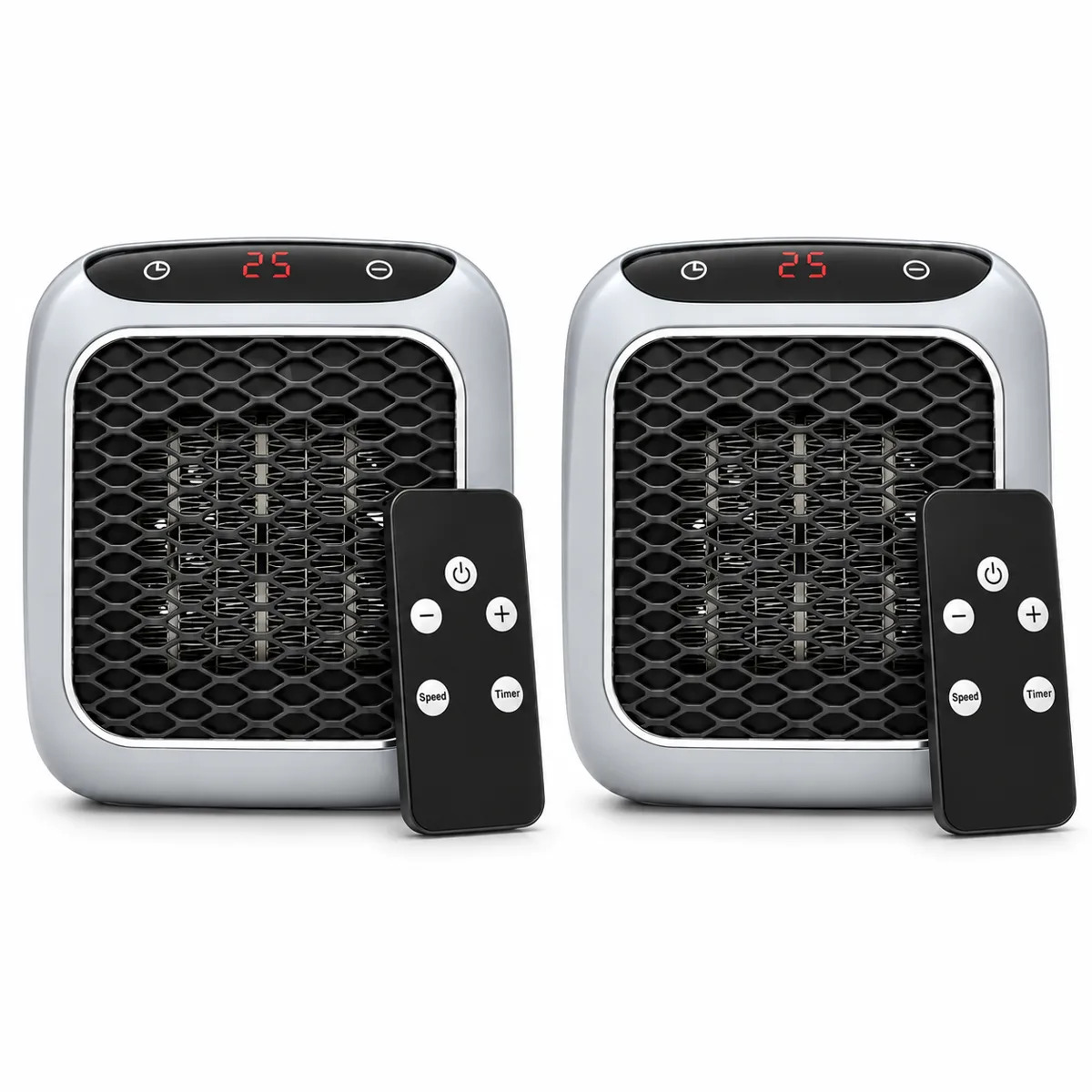
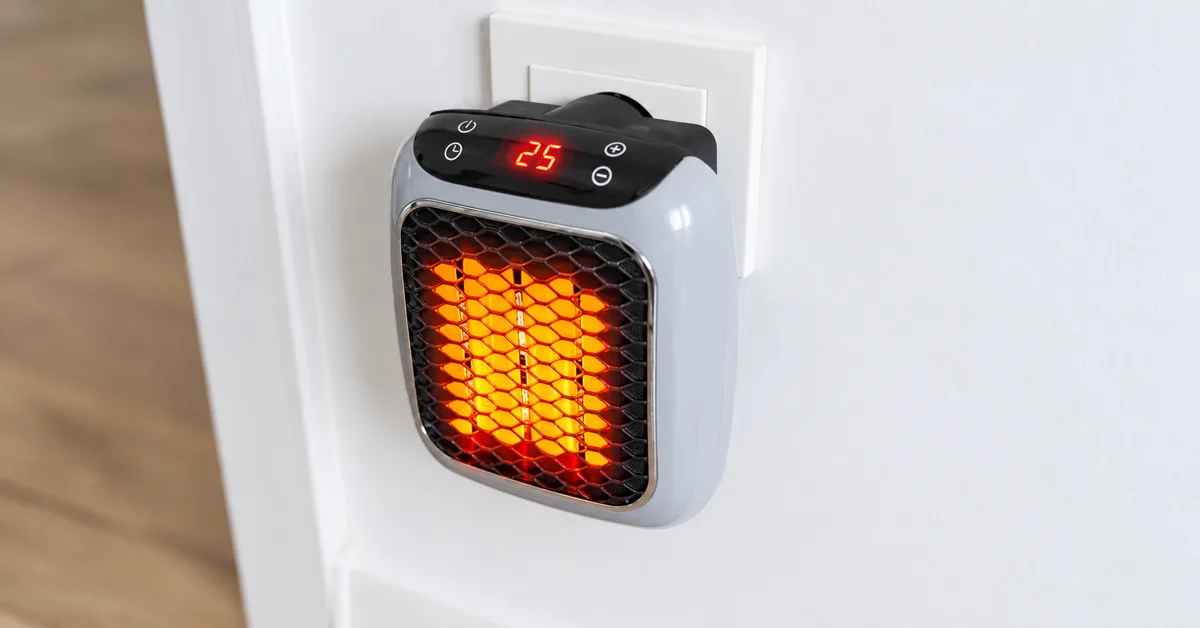
What is a wall plug heater?
A wall plug heater is supported at the socket rather than standing on the floor or attaching to wall brackets. It can suit someone who wants occasional heat without drilling, provided the socket location leaves the heater and its airflow unobstructed.
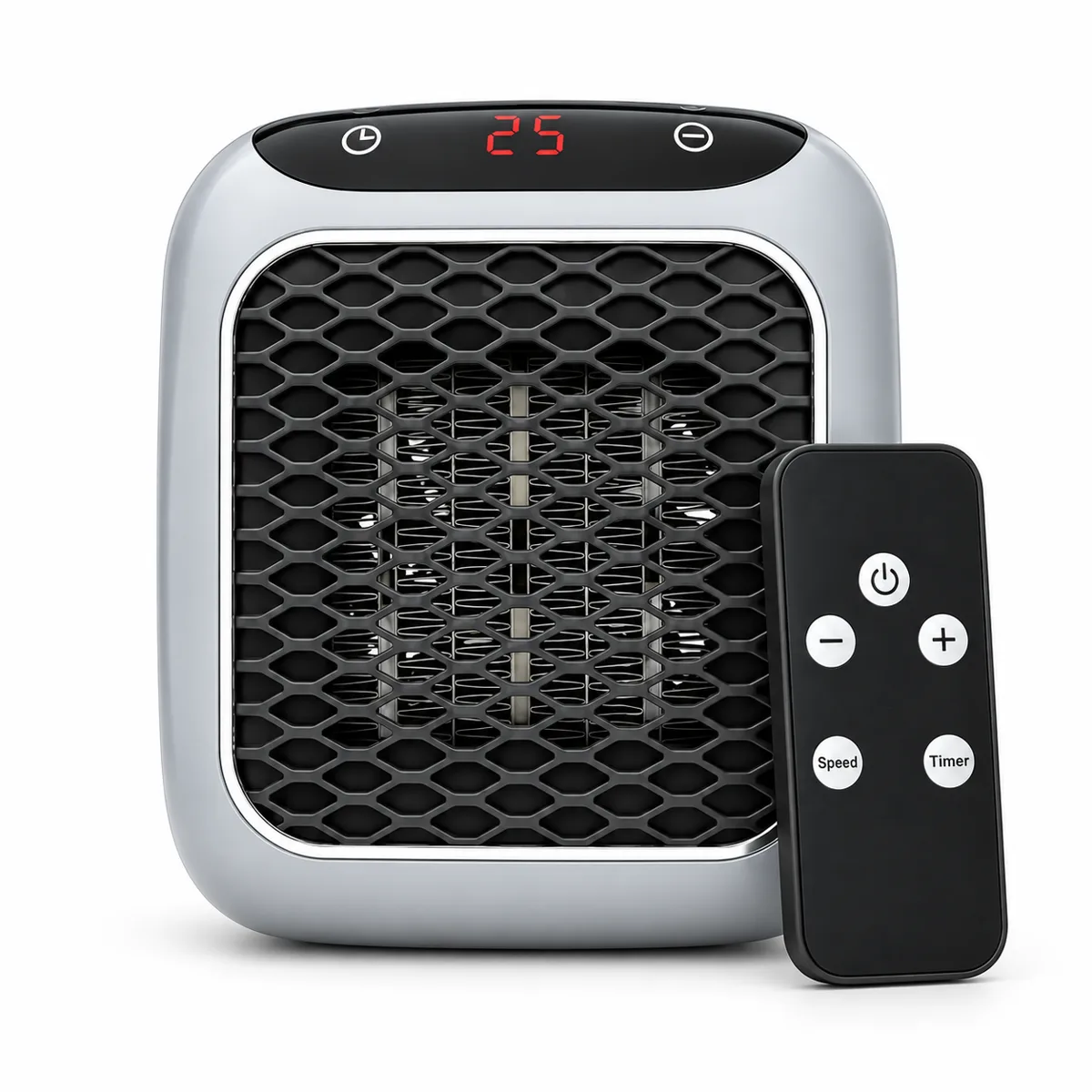
RapidHeat uses PTC ceramic plates and a fan, with an Irish/UK Type G plug. It offers 400W low and 800W high settings, an adjustable thermostat with LED display, a programmable timer and a remote control. See how RapidHeat works for the heating basics.
Is a wall plug heater the same as a wall-mounted heater?
| Question | Wall plug heater | Fixed wall-mounted heater |
|---|---|---|
| How is it supported? | Directly at a suitable socket | Brackets or other fixed fittings |
| Can it move rooms? | Yes, after switching off and cooling | Not intended for regular moving |
| What installation is needed? | No drilling for RapidHeat | Depends on model and electrical connection |
| What determines suitability? | Output and clear socket position | Output, mounting position and installation |
No. A fixed wall-mounted heater is secured to the building and may need professional electrical installation, depending on its design. A socket heater remains a movable appliance, even though it sits beside the wall during use.
Neither format is automatically more energy efficient. The right comparison is the heat output needed for your room, how you control it and whether installation is appropriate for your home.
Where can I safely position a socket heater?
Check the socket before deciding to buy. A socket hidden behind a sofa, under hanging curtains or beside bedding is not a suitable heating position. The remote control does not make an obstructed location safe.
Plug RapidHeat directly into a sound wall socket and keep the air inlet and outlet clear. Do not use an extension lead, cover the unit or use a damaged or loose socket. If a plug or socket shows overheating, stop using it and have the problem checked.
Keep children and pets away, and switch the heater off when leaving the room or going to sleep. Read the RapidHeat instructions rather than treating overheat protection and auto shut-off as substitutes for careful placement.
What size room can a wall plug heater heat?
| Room | Suitability | Before using it |
|---|---|---|
| Small study | Potentially suitable | Close the door and check socket clearance |
| Bedroom up to about 12 m² | Possible for awake heating sessions | Keep clear of bedding and curtains |
| Large open-plan room | Not suitable as the main heater | Assess a properly sized heating system |
| Poorly insulated conservatory | Not suitable on its own | Address heat loss and heating capacity |
| Bathroom or wet area | Not suitable for RapidHeat | It is not IP-rated |
RapidHeat is intended for a small room up to about 12 m² and can warm it in under five minutes under suitable conditions. That is not a guarantee for every room: draughts, high ceilings, glazing and a cold starting temperature all affect comfort.
How much does a plug-in heater cost to run in Ireland?
| Heater type | Typical power | Cost per hour* |
|---|---|---|
| RapidHeat (low) | 400W | €0.14 |
| RapidHeat (high) | 800W | €0.28 |
| Fan heater | 2,000W | €0.70 |
| Oil-filled radiator | 1,500–2,500W | €0.53–€0.88 |
| Halogen heater | 1,200W | €0.42 |
*At full power and an electricity unit rate of €0.35/kWh, close to typical Irish standard tariffs. Thermostats cycle heaters off once a room is warm, so real costs are usually lower.
At the example rate, running RapidHeat on low for four hours costs about €0.56, or roughly €17 for a 30-day month. On high, the same four-hour session costs €1.12 before any thermostat cycling.
A lower hourly cost reflects lower electricity input and less heat output, not extraordinary efficiency. Around one kilowatt-hour of electricity becomes one kilowatt-hour of heat in resistive heaters. Use the unit rate on your own bill when estimating your spending.
Can a wall plug heater replace central heating?
Not as a whole-house solution. A small socket heater can add warmth to an occupied study or bedroom, but it cannot distribute heat around the home like a correctly designed heating system. Leaving internal doors open makes its job harder, not broader.
For a room used all day throughout winter, compare its heat loss and heating options carefully. A fixed heater with suitable output may be more appropriate than a small appliance that runs continuously without reaching a comfortable temperature. Our electric heaters in Ireland guide explains the wider choices.
What are the pros and cons of a wall plug heater?
The convenience comes from the compact socket format. The main compromise is that you cannot freely choose the heating position independently of your wall sockets.
- Pro: no floor-standing unit or trailing extension lead is needed when used correctly.
- Pro: a renter can add temporary warmth without drilling into a wall.
- Pro: thermostat and timer controls help match heating to short sessions.
- Con: furniture or curtains may make existing sockets unusable.
- Con: RapidHeat has an audible fan at about 45 dB, so it is not silent.
- Con: an 800W maximum output cannot meet every room’s heating demand.
Can I use a wall plug heater in a bathroom?
Not RapidHeat. It is not IP-rated and must not be used in bathroom zones or wet areas. A standard socket, an open door or a timer does not change that limitation.
Bathroom heating needs equipment appropriate to the location and electrical safety requirements. Get advice from a qualified electrician rather than moving a bedroom heater near a bath or shower. Our bathroom heater guide explains why product suitability matters.
How can I reduce the cost of heating one room?
Close the room door, reduce unnecessary draughts without blocking required ventilation, and choose a comfortable thermostat setting. Close curtains when useful but keep them well clear of the heater. Use the timer to avoid heating after you have finished in the room.
Low power is useful if it maintains comfort; it is not a solution for a room losing more heat than the unit supplies. Compare smart or night-rate tariffs against the hours you actually need warmth. SEAI provides guidance on energy upgrades and grants, and Fuel Allowance may assist eligible households.
If damp or persistent cold is the underlying issue, investigate ventilation, insulation or leaks rather than simply adding another small heater. Our room heating cost guide covers practical ways to reduce waste.
Which wall plug heater bundle should I buy?
Start by counting suitable rooms, not spare sockets. One RapidHeat costs €59 including VAT, while the most popular two-pack costs €89. The three-pack is €119, or €39.67 each, and the four-pack is €179. Operating several together increases total electricity use.
RapidHeat is sold by the official Irish store rapidheatie.com, not Irish shops, Argos, Woodie’s or Amazon. Delivery is free to every county in the Republic of Ireland, with dispatch in 1–2 working days and delivery in 2–5 working days.
There is a 30-day money-back guarantee from delivery alongside statutory Irish and EU consumer rights. Check the returns information before ordering. Make your choice using the room requirements and product specifications.
Who RapidHeat is not right for
We'd rather you buy the right heater than return the wrong one. RapidHeat probably isn't for you if:
- Homes needing a replacement for whole-house heating.
- Rooms where every socket is blocked by furniture or fabric.
- Bathroom zones, wet areas or poorly insulated conservatories.
- Large open-plan spaces needing more than small-room top-up heat.
Frequently asked questions
Do wall plug heaters need installation?
RapidHeat plugs directly into a suitable Irish/UK Type G wall socket and does not need drilling. It still needs a sound socket and clear space around its airflow.
Can a socket heater warm a whole room?
RapidHeat is designed for a small room up to about 12 m². Insulation, draughts and ceiling height affect whether its 800W maximum is sufficient.
Can I put a wall plug heater behind a sofa?
No. Furniture can obstruct airflow and sit too close to the heat. Choose a clear socket rather than trying to hide the appliance.
Are wall plug heaters more efficient than fixed heaters?
Not inherently. Both resistive types convert electricity into heat in broadly the same way; output, controls and room heat loss determine practical use.
Can I use an extension lead to reach a better position?
Do not use RapidHeat with an extension lead. If there is no suitable direct wall socket, it is not the right appliance for that location.
Can I move it between rooms?
Yes, but switch it off and allow it to cool first. Check the new socket and surrounding area each time rather than assuming every room is suitable.